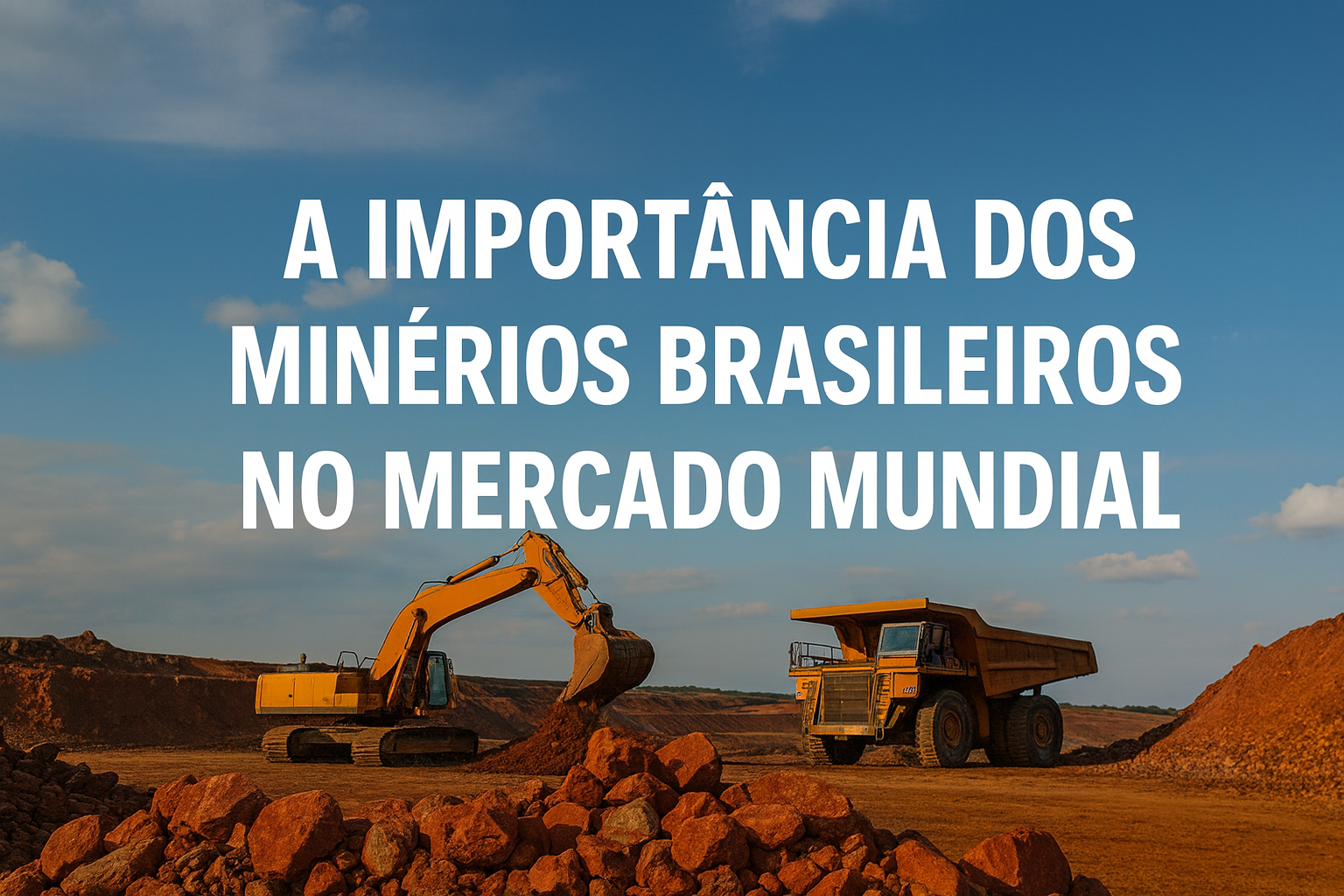
 Brazil holds a leading position in the global mining landscape, ranking among the world’s largest producers and exporters of minerals. With vast natural reserves and a wide diversity of resources, the country plays a key role in supplying raw materials essential for industry, energy, technology, and the transition toward a more sustainable economy.
Among the main highlights is iron ore, of which Brazil is one of the world’s largest exporters, supplying steel mills across Asia, Europe, and the Middle East. Brazil is also the global leader in niobium production, holding about 85% of the world’s known reserves—an essential mineral for the aerospace, automotive, and high-tech industries.
In addition, Brazil plays an important role in the production of bauxite (aluminum), manganese, gold, copper, and nickel, and has recently gained relevance in critical minerals for the energy transition, such as lithium and rare earth elements, which are vital for batteries, electric vehicles, solar panels, and electronic equipment.
The strength of the mining sector has a direct impact on Brazil’s trade balance, generates thousands of direct and indirect jobs, attracts foreign investment, and drives the development of entire regions, especially in the states of Minas Gerais, Pará, and Bahia.
On the international stage, amid the global search for secure supplies of strategic inputs, Brazil’s relevance grows as a reliable supplier of essential minerals for the world economy. At the same time, demands for responsible environmental practices, traceability, and sustainable mining are becoming increasingly central to the sector’s competitiveness.
As a result, Brazilian minerals remain one of the pillars of the national economy and a strategic asset in global trade, with a decisive role in the future of industry, innovation, and the global energy transition.
Brazil holds a leading position in the global mining landscape, ranking among the world’s largest producers and exporters of minerals. With vast natural reserves and a wide diversity of resources, the country plays a key role in supplying raw materials essential for industry, energy, technology, and the transition toward a more sustainable economy.
Among the main highlights is iron ore, of which Brazil is one of the world’s largest exporters, supplying steel mills across Asia, Europe, and the Middle East. Brazil is also the global leader in niobium production, holding about 85% of the world’s known reserves—an essential mineral for the aerospace, automotive, and high-tech industries.
In addition, Brazil plays an important role in the production of bauxite (aluminum), manganese, gold, copper, and nickel, and has recently gained relevance in critical minerals for the energy transition, such as lithium and rare earth elements, which are vital for batteries, electric vehicles, solar panels, and electronic equipment.
The strength of the mining sector has a direct impact on Brazil’s trade balance, generates thousands of direct and indirect jobs, attracts foreign investment, and drives the development of entire regions, especially in the states of Minas Gerais, Pará, and Bahia.
On the international stage, amid the global search for secure supplies of strategic inputs, Brazil’s relevance grows as a reliable supplier of essential minerals for the world economy. At the same time, demands for responsible environmental practices, traceability, and sustainable mining are becoming increasingly central to the sector’s competitiveness.
As a result, Brazilian minerals remain one of the pillars of the national economy and a strategic asset in global trade, with a decisive role in the future of industry, innovation, and the global energy transition.
Brazil holds a leading position in the global mining landscape, ranking among the world’s largest producers and exporters of minerals. With vast natural reserves and a wide diversity of resources, the country plays a key role in supplying raw materials essential for industry, energy, technology, and the transition toward a more sustainable economy.
Among the main highlights is iron ore, of which Brazil is one of the world’s largest exporters, supplying steel mills across Asia, Europe, and the Middle East. Brazil is also the global leader in niobium production, holding about 85% of the world’s known reserves—an essential mineral for the aerospace, automotive, and high-tech industries.
In addition, Brazil plays an important role in the production of bauxite (aluminum), manganese, gold, copper, and nickel, and has recently gained relevance in critical minerals for the energy transition, such as lithium and rare earth elements, which are vital for batteries, electric vehicles, solar panels, and electronic equipment.
The strength of the mining sector has a direct impact on Brazil’s trade balance, generates thousands of direct and indirect jobs, attracts foreign investment, and drives the development of entire regions, especially in the states of Minas Gerais, Pará, and Bahia.
On the international stage, amid the global search for secure supplies of strategic inputs, Brazil’s relevance grows as a reliable supplier of essential minerals for the world economy. At the same time, demands for responsible environmental practices, traceability, and sustainable mining are becoming increasingly central to the sector’s competitiveness.
As a result, Brazilian minerals remain one of the pillars of the national economy and a strategic asset in global trade, with a decisive role in the future of industry, innovation, and the global energy transition.
Brazil holds a leading position in the global mining landscape, ranking among the world’s largest producers and exporters of minerals. With vast natural reserves and a wide diversity of resources, the country plays a key role in supplying raw materials essential for industry, energy, technology, and the transition toward a more sustainable economy.
Among the main highlights is iron ore, of which Brazil is one of the world’s largest exporters, supplying steel mills across Asia, Europe, and the Middle East. Brazil is also the global leader in niobium production, holding about 85% of the world’s known reserves—an essential mineral for the aerospace, automotive, and high-tech industries.
In addition, Brazil plays an important role in the production of bauxite (aluminum), manganese, gold, copper, and nickel, and has recently gained relevance in critical minerals for the energy transition, such as lithium and rare earth elements, which are vital for batteries, electric vehicles, solar panels, and electronic equipment.
The strength of the mining sector has a direct impact on Brazil’s trade balance, generates thousands of direct and indirect jobs, attracts foreign investment, and drives the development of entire regions, especially in the states of Minas Gerais, Pará, and Bahia.
On the international stage, amid the global search for secure supplies of strategic inputs, Brazil’s relevance grows as a reliable supplier of essential minerals for the world economy. At the same time, demands for responsible environmental practices, traceability, and sustainable mining are becoming increasingly central to the sector’s competitiveness.
As a result, Brazilian minerals remain one of the pillars of the national economy and a strategic asset in global trade, with a decisive role in the future of industry, innovation, and the global energy transition.